Posts

Showing posts with the label great plants

Hip Hip Hooray for Rose Hips!

Image
rose hips photo by Jan Johnsen  Allow your roses to form hips.   Did you know that, like  many plants that produce fruit, the formation of rose hips is a signal to the rose to go dormant for the season? from Monrovia - Japanese rose  Rose hips provide wonderful color in the garden and are a good source of vitamin C for birds in the fall and winter.  They are one of the highest plant sources of Vitamin C. 'Cherry Pie' Rose makes great rose hips: Oso Easy Cherry Pie Rose -from May Dreams Garden Blog  You can eat them too. Rose hips are used for jam, jelly, syrup, soup, beverages, pies, bread, and wine.  They can also be eaten raw if care is used to avoid the hairs inside the fruit.   The redder they are, the softer and sweeter.   source: live by the sun blog  for more info on roses go to Chris Van Cleave - click here . 

The Famed Yellow Magnolias Bred in Ossining N.Y.

Image
'Elizabeth' Magnolia was bred by Brooklyn Botanic Garden in Ossining, NY.   I love yellow-flowering magnolias. The cover of a Garden Design Magazine features one and it makes my heart skip a beat. The Brooklyn Botanic Garden introduced the yellow-flowering magnolia to the world. BBG  launched the breeding program in 1953 at its R&D facility, the Kitchawan Research Center, in Ossining, New York (the town next door to me). They bred eight magnolias before the program shut down at Kitchawan in 1991. These BBG hybrids are still available today. These beauties flower between mid-April and mid-May. Magnolia  x ‘Elizabeth’ One of my favorites is  Magnolia  x ‘Elizabeth’  which was introduced in 1977. It is a cross between  M. acuminata  and  M. denudata.  Dr. Evamaria Sperber, who helped start BBG’s breeding program bred this tree. It is valued because it flowers before the leaves come out which makes an elega...

My new book, Floratopia, is Out Now!

Image
My new book Floratopia is out! I am so happy to finally be able to share flower garden design ideas with everyone. I have been working with annual and perennial flowers in all my landscape projects for decades and yet I wrote about everything but flowers.  Odd. Well, that has now been corrected. I have amassed a collection of flower tips accompanied by my photos and categorized them in 6 sections in the book.  Osteospermum Serenity Series Why did I write this book? Here is an excerpt from my introduction: "Flowers are such an important part of our living world—offering food and habitat to our threat-  ened pollinators such as bees, birds, butterflies, and more. That is why I chose to write about  flowers and flower garden design. I have worked with flowers as a landscape designer and  horticulturist all my adult life, and I know how wonderful it is to open the door to the sight of  colorful blooms in the garden. More important, I believe we need flower gard...

Praise for the lowly Dandelion

Image
Every year I reprint this at dandelion time where I live-   The dreaded Dandelion (Taraxacum officinale) , for which we spend tremendous amounts of weed killer money to eradicate, has been prized over the years for its medicinal and nutritious properties. In fact, dandelion roots, flowers and "dandelion greens" (leaves) are all edible! Dandelions are a rich source of vitamins A, B complex, C, and D, as well as minerals such as iron, potassium, and zinc. And in traditional medicine, dandelion roots and leaves were used to treat liver problems. Native Americans used dandelion decoctions (liquid made by boiling down the herb in water) to treat kidney disease, swelling, skin problems, heartburn, and stomach upset. Young Dandelion leaves • Dandelion roots can be roasted as a coffee-substitute, or boiled and stir-fried as a cooked vegetable. • Dandelion flowers can be made into a wine. • Dandelion greens can be boiled, as you would spin...

Variegated Solomon's Seal - Deer resistant plant

Image
'Angel Wings' Variegated Solomon's Seal  I was talking to someone in my town who had shade in their yard and deer  problems..and I suggested Variegated Solomon's Seal ( Polygonatum odoratum ‘Variegatum’)  to them... It was the 2013 Perennial Plant of the Year is  Award. It is deer resistant and loves shade. This woodland gem  grows 18 to 24 inches tall. It is a great companion plant to hostas, brunnera, dicentra, ferns, and astilbes.  The sweet fragrance of its small, bell-shaped white flowers will enhance your walk along a pathway on a spring morning. You can use its variegated foliage in spring floral arrangements. And it offers yellow fall foliage color. photo by George Weigel It will spread by rhizomes to form colonies.  Increase by dividing clumps every two to three years. photo by Rush Creek growers I grow this in my yard and every year it spreads and looks so wonderful.  Click here for a list of a...

Some Plants for a Meadow Planting

Image
The “meadow planting” style of gardening that is so popular now includes plants from various German breeders. Of course you can plant the original native species to help our pollinators...  Click on the links in the captions for more information. Karl Foerster bred tall, hardy plants suited to the northern European climate.  He  called grasses “Mother Nature’s hair”  and one of his best known and popular plants is the strongly vertical  Calamagrostis x acutiflora 'Karl Foerster’ (a form of feather-reed grass). Karl Foerster Feather Reed Grass Karl Foerster feather reed grass in background. Sedum Matrona on right. Ernst Pagels  developed new varieties of Miscanthus sinensis .   Piet Oudolf was a friend of Pagels and uses his plants, among others .  Pagels developed Miscanthus sinensis 'Malepartus' which looks like Pampas grass but blooms in midsummer so people in cooler climates can enjoy the bloom.  Hoffman ...

A Hummingbird Magnet-VERMILION BLUFFS® Mexican Sage

Image
Mexican Salvia - Vermilion Bluffs®   Do you want Hummngbirds to live in your garden next year?  Well, hummingbirds love red and they love salvia flowers. So next spring plant the hardy  Vermilion Bluffs® Mexican Sage ( Salvia darcyi 'Pscarl').   This 4 foot tall, easy to grow, perennial is a show stopper with its brilliant scarlet flowers that  are borne on 3 foot erect spires from July to October.  Not many garden perennials can boast this length of blooming season.   The foliage and stems are very aromatic.  After frost, the leaves die to the ground and then return in spring.  Vermillion Blluffs Mexican Sage from Plant Select - click here Place it in a sunny area or in containers in loamy s oil with  good drainage. When its starts blooming the red color and sweet nectar in the bright flowers will brin g hummingbirds to your yard. Its underground runners form a tough mat that blocks weeds. ...

Hydrangea Tardiva - Late blooming Hydrangea to Extend the Season

Image
I must admit - I love Tardiva Hydrangea. Hydrangea paniculata 'Tardiva' is a loose, carefree shrub that defines exuberance. It is one of the panicle hydrangeas that received a 2010 Cary Award for Outstanding Shrub for New England Gardens. It adapts easily to many situations, blooms  late  in the summer which extends the garden season into October and can be pruned as a small tree if so desired. Tardiva is known for its long, lacy white flowers. They are tinted a pale pink which become darker as the season progresses. This hydrangea can tolerate half shade and is disease resistant. I prune Tardiva in very early spring, leaving just a few buds on the stem - this ensures larger flowers on stiffer branches. Tardiva hydrangeas fit in well in a woodland theme garden as well as in classic mixed flower borders. They make a great screen in the summer and are striking when planted in a mass planting.  They also make a wonderful dried cut f...

Blue and the Deer Resistant Angelonia flower

Image
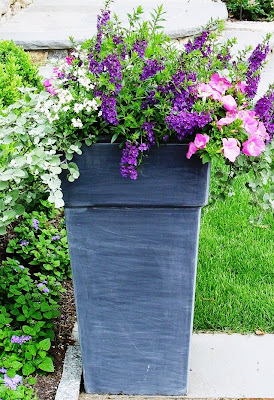
This is the most popular blog post in Serenity in the Garden so I decided to re-post it... The wonderful Deer Resistant Blue Angelonia flower. (Angelonia with Helichrysum, petunia, Johnsen Landscapes) Blue is everyone's "favorite color."  It is, hands down, the most popular color worldwide and is the least "gender specific" color, having equal appeal to both men and women. Now Purple is giving blue a run for its money as the second favorite color.... Blue is the favored color for toothbrushes, so that says it all!  ( this info is from a great website:  Sensation Color )  but can purple be far behind? Scientists have found that the color blue causes the body to produce chemicals that are calming. This may be why we all like to be around blue....stare at this square and see if it calms you. In fact, over the past decade, scientists have reported the successful use of blue light in the treatment of psychological problems such a...