Posts

The Daffodils of Croton-on-Hudson

Image
I grew up in New York City playing on sidewalks and cement school yards amidst a gridded world of city streets and tall buildings. There wasn't much natural beauty around me.. (my elementary school - P.S. 8 Brooklyn) My salvation was my frequent visits to family friends who lived  in lush, green Westchester County, a 45 minute train ride away from NYC.   Each time my father and I went to the exotic realm of small towns, rock strewn woodlands and country roads, we would hop a train from the venerable Grand Central Terminal. Back then Grand Central was not the restored gem  it is today. But one thing I loved there was the giant and garish Kodak photo billboard photo. It was like a giant LCD screen - something unknown then. One Easter weekend, as we headed for the train, I looked up to see a giant panoramic photo of a hillside of yellow daffodils. It was breathtaking! I had never seen such a thing before - thousands of yellow flowers popping out of ...

Tulip Time in Holland, Michigan

Image
In 1999 I suggested to my village of Croton on Hudson that we plant daffodils all around the village in mass quantities..They're deer resistant, come back every year and multiply....I figured we could create a daffodil village in much the same way Holland, Michigan is the 'tulip town'. The  Holland Michigan Tulip Festival displays over six million of the town's signature flower every year. Also known as the Tulip Time Festival, it is the largest tulip festival in the United States and Reader's Digest has named it the best small town festival in the country. Indeed, this year Holland Michigan was named by Money Magazine one of the top ten places to retire, partially due to its cultural assets and large amounts of green space. I bet the tulip festival has something to do with this because any town that dedicates itself to flowers has got to be special! The idea of Tulip Time was introduced in 1927 at a Woman's Literary Club meeting by Miss L...

Trompe L’oeil for the 21st century

Image
The record levels of rain we have been experiencing in my part of the world have made my local landmark, the Croton Dam, quite an attraction.  I visited there a few days ago with my design class from Columbia University.  The spillway to the side of the dam was quite a torrent!  Like Niagara Falls, the power of this waterfall was almost too much to bear...but what a reminder of nature and the energy she holds. (this is the dam and spillway in normal times) The raging waters brought to my mind the use of water in a garden.... One day in 2007 I was driving along a road in my area when I saw a long wall of falling water that wasn't there before. The water was gushing over the wall but I saw no evidence of any water beyond that ...hmmm I had to stop the car and take a picture. Then I had to walk up there and see what was going on.... It was an art installation using photo-derived imagery of a waterfall.  A digital print on vinyl  - trom...

Depressed? Try This!

Image
Hello! Its a great day, isn't it?   what? You don't necessarily agree...you're depressed?   Well then, go out and plant something!   Studies have found that an hour of gardening a day reduces the risk of heart disease and stroke and increases bone density more efficiently than aerobics or swimming! In fact, even looking at nature can result in a fall in blood pressure within five minutes and lower our stress hormones.   One 16-year study in Australia revealed that those who did daily gardening even cut their risk of getting dementia in later life.   (Gardening boosts endorphins, the body’s good-mood chemicals. Personally, my theory is that we need the sunlight on our pineal gland and this can delay dementia, but I have no proof, its just a 'knowing feeling') ..... Here is a lovely story from Timesonline United Kingdom, dated March 27, 2010 "...Jane Robertson was earning a small fortune in the pressured world of derivatives marke...

Grow Stevia - The Natural Zero Calorie Sweetener

Image
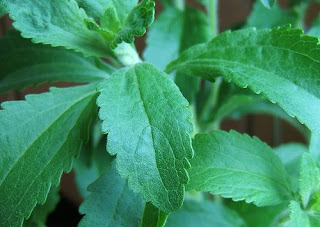
(photo from Civil Eats ) In 2008  the Food and Drug Administration declared a natural zero-calorie sweetener derived from the herb Stevia safe for use in foods and beverages. A long time favorite of natural foodies, Stevia, or sweetleaf, is a tender herb native to South America (zones 10, 11 ). Its extract is widely sold here as the tabletop sweetener, Truvia. There is a good reason why stevia is called sweetleaf. Its dried leaves are 15 times sweeter than ordinary table sugar and a glycoside that can be extracted from Stevia leaves is 300 times sweeter than sucrose! In Japan stevia has been sold as a sweetener for over 30 years and they use it in their version of Coke. It  is also available  in Brazil and China. Stevia is banned for use in food in the European Union. The story of stevia is quite interesting. It shows how a natural product can be banned by the government, only to be adopted by the largest multi-national beverage manufacturers in...

Ovals in the Landscape - Elegance, Healing and Celebration

Image
(Garden by Johnsen Landscapes & Pools ) Ovals and ellipses add an understated elegance to the landscape. These elongated circles are perfect for ceremonial outdoor spaces and  promote movement in a garden.  Ellipses, ovals and the familiar 'racetrack' shape all contribute to a harmonious atmosphere outdoors. (Garden by Johnsen Landscapes & Pools ) I utilized an oval shape when I created this level lawn on the side of a steeply sloping hill.  I cut into the steep slope and retained it with a 3'10" ft high reinforced stone wall on the uphill side and a similar wall, which you can't see, down below on the downhill side of the lawn. This special lawn was designed for the dimensions of a large tent to be used once a year for a grand outdoor party for children afflicted with brain and spinal cord tumors. The Making Headway Foundation is the host of this wonderful event and the kids love it! The most prom...

Now is the time! Don't delay!

Image
We all know that herbicides can harm us and the environment, so it follows that scientists are studying natural  weed control methods. A team at Michigan State University recently studied the effectiveness of mulched maple and oak leaves on common dandelions in bluegrass lawns. The team tested chopped up leaves of red maple, silver maple, sugar maple and red oak and looked to see how they worked to suppress dandelions in a lawn. They found that after one and two mulch applications (at a high rate of mulching)  up to 80% and 53% reduction in dandelions was achieved, respectively. This makes sense since leaves lay naturally on a meadow and are not blown off. They block light and water and suppress weed growth.. But we, lawn owners, immediately blow off all the leaves on our lawn in our 'early spring clean up' which opens up sun to all weed seeds. We then apply pre emergent weed killers to prevent the dandelio...